





Learn how social media marketing for businesses drives real leads and brand growth, with practical strategies you can start using today.
On this page10 sections
- 01How Does Social Media Help Businesses Grow?
- 02How Can Businesses Generate Leads Through Social Media?
- 03Building a Social Media Marketing Strategy
- 04Choosing the Right Platforms for Small Businesses
- 05Turning Followers Into Customers
- 06Practical Tips for Lead Generation
- 07Common Mistakes to Avoid
- 08Conclusion
- 09Get in touch with Brand Elite
- 10FAQs
Learn how social media marketing for businesses drives real leads and brand growth, with practical strategies you can start using today.
Most businesses are already on social media. Far fewer are actually generating leads from it. That gap is what this guide addresses: how social media marketing for businesses moves beyond likes and followers to become a genuine source of leads, customers, and brand growth.
How Does Social Media Help Businesses Grow?
Social media helps businesses grow by increasing visibility to the right audience, building trust through consistent content, and creating direct channels for engagement before someone is ready to buy. A large majority of businesses — often cited around 70% — now advertise on social media, and platforms are reported to receive a meaningful share of overall marketing budgets. This reflects that social platforms have become a core part of how businesses build awareness and find customers, not a side activity.
Growth generally comes from three overlapping effects:
- Visibility — appearing where your audience already spends time.
- Trust — demonstrating expertise and responding to questions publicly.
- Direct response — giving people a low-friction way to engage or buy.
How Can Businesses Generate Leads Through Social Media?
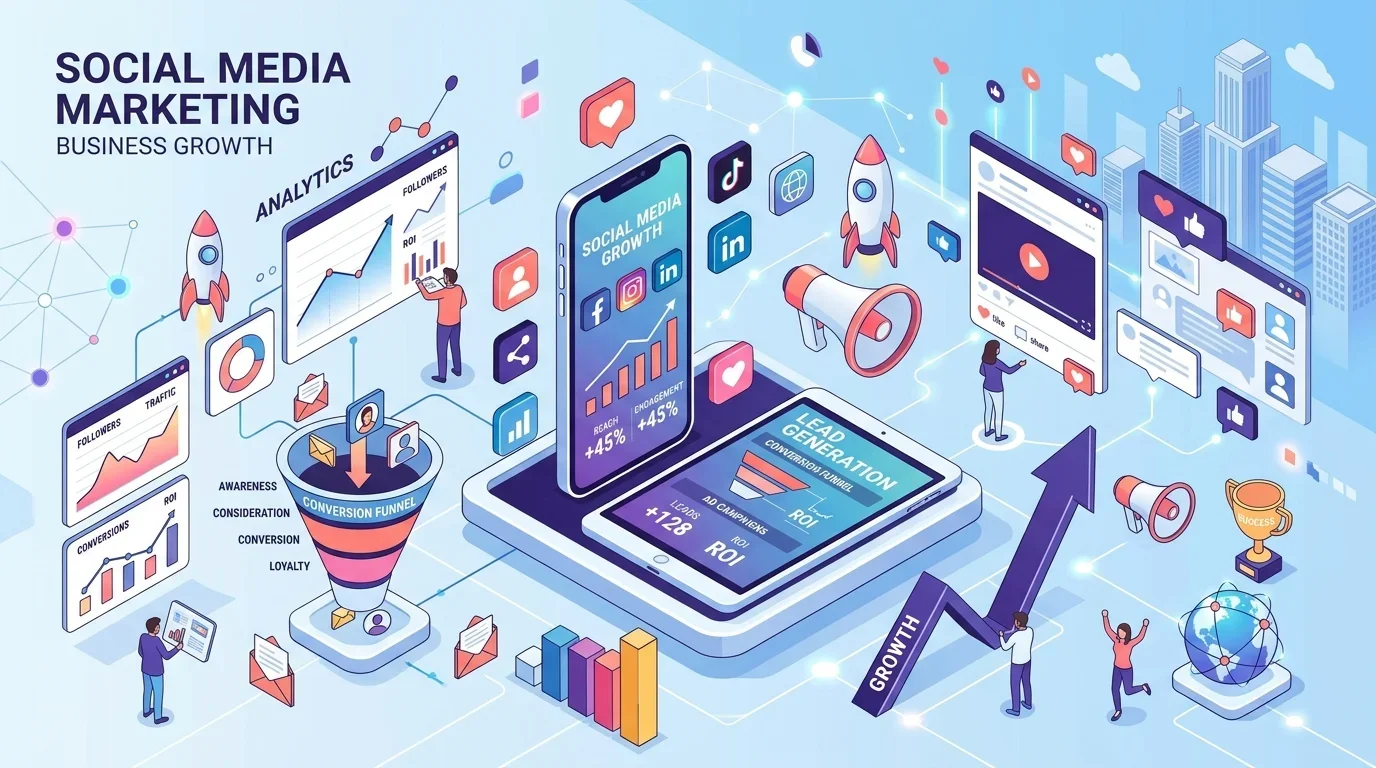
Businesses generate leads through social media by combining useful, targeted content with clear calls-to-action, lead capture tools (forms, DMs, link-in-bio pages), and consistent follow-up. The post that gets attention is rarely the same step where someone converts — which is why social media lead generation works best as a structured funnel, not a one-off campaign. Roughly two-thirds of marketers report that social media has helped them generate leads, with LinkedIn frequently cited as the strongest channel for B2B leads specifically.
Building a Social Media Marketing Strategy
A common mistake is treating social media as a content calendar to fill, rather than a social media marketing strategy built around a goal. A working strategy defines:
- Who you're trying to reach (specific segments, not "everyone")
- Where they spend time (not every platform suits every business)
- What you want them to do (follow, click, message, book, buy)
- How you'll measure success (leads and conversions, not just engagement)
Vague goals like "grow our following" rarely translate into business results on their own — define measurable targets like inquiries per month or form fills before creating content.
Choosing the Right Platforms for Small Businesses
For social media marketing for small businesses, focus tends to outperform breadth.
| Platform | Best suited for |
|---|---|
| Visual products, local/retail brands | |
| Local services, community businesses | |
| B2B services, consulting | |
| YouTube | Demonstrable products/services |
| Home, fashion, food, design brands |
2026 industry reporting shows Meta platforms (Facebook and Instagram) receiving the largest share of marketing budget allocation, followed by LinkedIn and TikTok — though the right mix depends on where your specific audience is active.
Turning Followers Into Customers
Understanding how to turn social media followers into customers means building a path, not expecting one post to do all the work:
- Attract with value, not just promotion. A "how we make it" post typically outperforms a plain "order now" post in trust-building.
- Capture interest with a clear next step — a link in bio, "DM us to book," or lead form.
- Nurture through direct engagement. Leads rarely convert from a single touchpoint; timely replies to comments and DMs do much of the real work.
- Convert with low-friction offers — a free consultation or "book a call" button reduces the effort needed to act.
- Retain and refer. Engaged customers often become a business's most credible marketing asset through reviews and word-of-mouth.
Practical Tips for Lead Generation
- Use platform-native lead tools — lead ads, LinkedIn forms, WhatsApp Business links reduce steps to contact.
- Show real results and testimonials rather than generic claims.
- Post consistently, not just frequently — a sustainable rhythm beats sporadic bursts.
- Respond quickly — unanswered comments and DMs often represent lost leads.
- Track what converts — clicks, DMs, and form fills, not just likes.
- Use video where possible — short-form video continues to see strong engagement across most platforms.
Beyond direct leads, social media for business growth also shows up through brand recall, public customer service, real-time market feedback, and attracting partners or talent.
Common Mistakes to Avoid
- Treating social media as a broadcast channel only, without engaging back
- Inconsistent branding across platforms
- No clear call-to-action on content
- Ignoring analytics and repeating what "feels" like it's working
- Over-promising in captions or ads, which damages long-term trust
Conclusion
Social media marketing for businesses works best as a structured, ongoing effort — the right platforms, valuable content, clear calls-to-action, and consistent follow-up — rather than a checklist of posts. Turning followers into customers takes a deliberate funnel, and businesses that track what's actually converting tend to see stronger results than those chasing trends. Connecting your social presence with your broader digital marketing strategy helps ensure it supports, rather than operates separately from, your overall growth goals.
Get in touch with Brand Elite
Frequently Asked Questions (FAQs)
1. How does social media help businesses grow?
It increases visibility, builds trust through consistent content, and creates low-friction ways for potential customers to engage before buying.
2. How can businesses generate leads through social media?
By combining useful content with clear calls-to-action, lead capture tools, and consistent follow-up — treated as a funnel, not a single campaign.
3. Which platform is best for lead generation?
It depends on the business — LinkedIn tends to work well for B2B, while Instagram and Facebook often suit visual, local, or consumer-facing businesses.
4. How often should a small business post?
Consistency matters more than frequency; a realistic, sustainable schedule outperforms sporadic high-volume posting.
5. Can social media replace a business website?
Generally not — social media excels at discovery and engagement, while a website typically still handles detailed information and structured lead capture.
6. How long before results show up?
This varies, but meaningful lead generation usually takes a few months of consistent activity to build momentum.
7. Is paid advertising necessary, or does organic content work alone?
Both can generate leads but serve different roles — organic builds ongoing trust, while paid promotion accelerates reach. Many businesses use a mix of both.